Crisis communication

When it matters most, preparation matters most

In the technology sector, where data breaches, service outages, regulatory investigations, and reputational incidents can unfold publicly and at speed, the question is rarely whether a crisis will occur. It is whether your organisation is prepared to manage one when it does.

Crisis communication is one of the most consequential areas of PR practice, and one of the most frequently underinvested. Businesses that handle crises well tend to emerge from them with their reputations intact, sometimes even stronger. Those that handle them badly can face lasting damage that takes years to repair, not because the underlying incident was necessarily more serious, but because the communication response compounded it.

Semaphore’s crisis communication service is designed to help technology businesses prepare for the unexpected and manage the reality if it arrives. We bring the experience, the composure, and the strategic thinking that high-stakes communication demands.

How it works

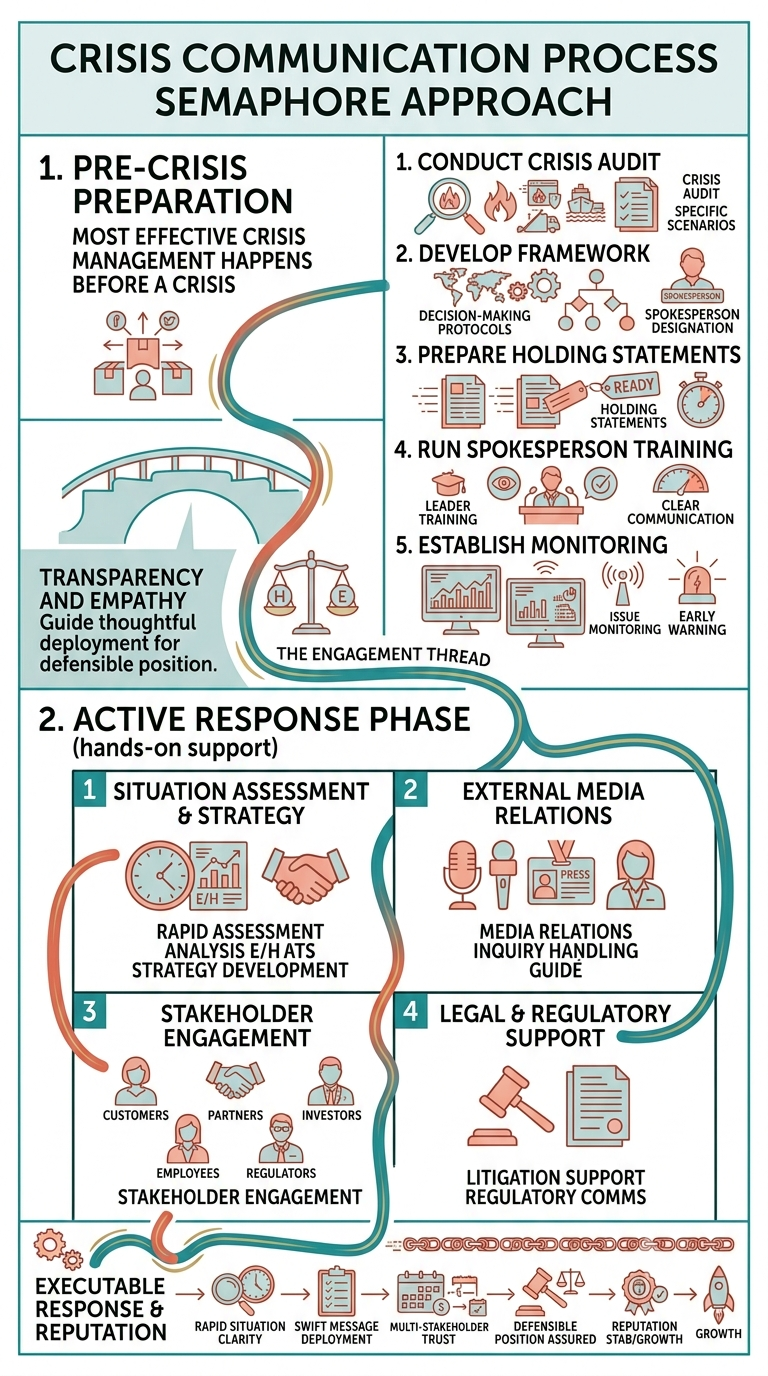
Crisis communication at Semaphore operates across two phases: preparation and response.

Preparation

The most effective crisis management happens before a crisis. We work with clients to:

  • Conduct a crisis audit that identifies the specific scenarios most likely to affect your business
  • Develop a crisis communication framework, including decision-making protocols, spokesperson designation, and approval chains
  • Prepare holding statements and scenario-specific messaging that can be deployed quickly when time is short
  • Run spokesperson training to ensure your leadership team can communicate clearly and confidently under pressure
  • Establish monitoring processes that provide early warning of emerging issues before they become public crises

Response

When a crisis is active, we provide immediate, hands-on support:

  • Rapid assessment of the situation and its likely trajectory
  • Development of a communication strategy that is honest, empathetic, and aligned to your legal and operational response
  • Media relations management, including proactive statements, journalist enquiry handling, and real-time guidance
  • Stakeholder communication across customers, partners, investors, employees, and regulators as required
  • Litigation support communications where legal proceedings are involved or anticipated

Throughout, our approach is guided by the principle that transparency and empathy, deployed thoughtfully, are almost always the most defensible position.

Alt Text

Why work with Semaphore

Crisis communication requires a specific combination of qualities that are not equally distributed across the PR industry. You need people who are calm under pressure, experienced with the media, and capable of thinking clearly about long-term reputational consequences in the middle of a short-term emergency.

Our all-senior team means that when a crisis hits, you are working with professionals who have managed difficult situations before. We have handled crises across data privacy, service interruption failures, personnel matters, and regulatory scrutiny, in both proactive and reactive modes.

We also understand the intersection of communications and legal risk. We work closely with legal counsel where required, ensuring that what we say publicly does not create downstream legal exposure while still meeting the standards of transparent and credible communication that media and stakeholders expect.

Reviews

In summary

Crisis communication is not an area where you want to be improvising. The businesses that navigate crises most successfully are those that have invested in preparation, have the right advisors in place, and respond with clarity and integrity when the situation demands it. Semaphore has the experience, the relationships, and the strategic discipline to support you through both.

If you would like to assess your current crisis preparedness or discuss how we can support your communications in a live situation, we are ready to have that conversation.

Frequently Asked Questions

What qualifies as a crisis from a communications perspective?

A communications crisis is any situation that poses a significant threat to your organisation’s reputation, relationships, or licence to operate, and that requires a coordinated public or stakeholder communication response. This can include data breaches, service failures, regulatory action, leadership misconduct, financial irregularities, product recalls, or any event that attracts significant negative media or public attention. The threshold varies by business, which is why a crisis audit is a useful first step.

How quickly can Semaphore respond in an active crisis?

We operate with the understanding that crises do not wait for business hours. For retained crisis clients, we have agreed response protocols in place that allow us to mobilise quickly. For new engagements, we will always do our best to respond within hours. The practical reality is that a relationship established before a crisis allows for much faster and more effective response than one being built in the middle of one.

Should we involve our legal team in a crisis communication response?

In most cases, yes. Legal and communications counsel need to operate in close coordination during a crisis, but they serve different objectives. Legal counsel focuses on minimising liability. Communications counsel focuses on maintaining or restoring reputation and trust. These objectives are not always in conflict, but managing the tension between them requires experience. Semaphore is accustomed to working alongside legal teams and can help navigate situations where legal and communications considerations need to be balanced carefully.

What is the most common mistake businesses make in a crisis?

Saying nothing for too long. The instinct to wait until all the facts are established before communicating is understandable, but it almost always makes things worse. Silence creates a vacuum that others will fill, usually unfavourably. A well-crafted holding statement that acknowledges the situation, demonstrates that it is being taken seriously, and commits to further communication can preserve significant reputational ground while a fuller response is being prepared.

Can you help us prepare even if we have never had a crisis?

That is precisely when to prepare. A crisis audit and communication framework developed in calm conditions is infinitely more useful than one assembled under pressure. We can work with your leadership team to identify the scenarios most relevant to your business, build the protocols and messaging needed to respond effectively, and conduct spokesperson training so that your team is genuinely ready if the situation arises.

Do not wait for a crisis to find out whether you are ready for one.