PR Strategy

Finding the signal in the noise

Every technology business has a story and a uniqueness that sets them apart. The difficulty lies in surfacing it, putting it into words, and then getting it in front of the right people with enough clarity and proof so it’s believed and remembered. That is what a well-constructed PR strategy does.

At Semaphore, PR strategy is the foundation of everything we do. Before a single press release is drafted, we invest in understanding who you are, what you stand for, and why that matters to the market you want to reach. The result is a positioning framework and communications plan built around your specific business goals.

Whether you are a fintech challenger looking to gain credibility with enterprise buyers, a software company expanding into new territories, or an established brand navigating a period of change, a clear PR strategy creates the blueprint for your communications to systematically advance your overall goal, rather than just create a temporary spike of publicity.

How it works

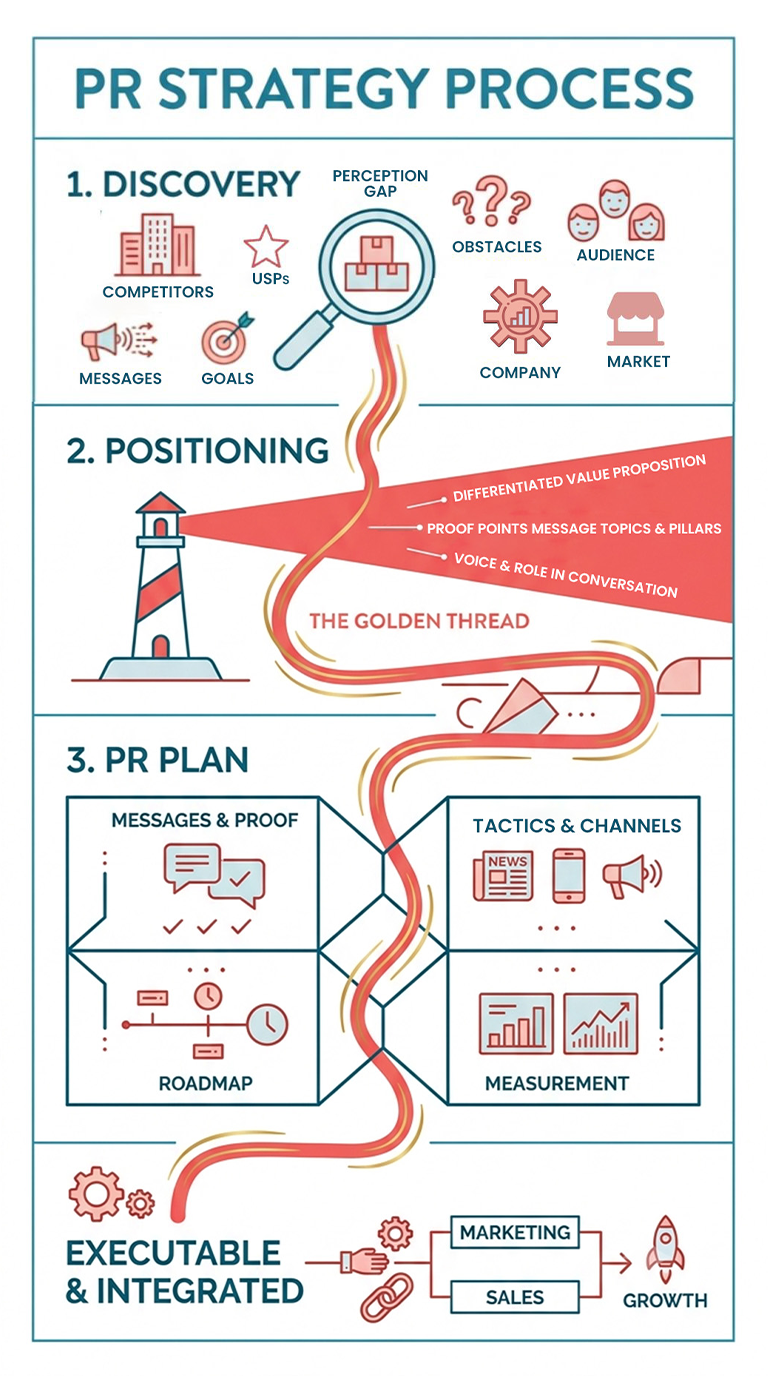
Our PR strategy process starts with a thorough discovery phase. We examine your business from multiple angles: the products or services you offer, the problems you solve, the audiences you need to reach, the competitors you come up against, and the perception gaps that exist in the market today.

From that foundation, we build your positioning. This is the golden thread that runs through all of your communications.  It becomes a substantiated point of view that only your business can credibly own, articulated in a way that makes sense to the people you are trying to influence.

Once positioning is established, we translate it into a structured PR plan. This includes:

  • Core messages, tailored by audience, and proof points
  • A media and channel strategy that identifies where your target audiences gather
  • A content and engagement roadmap aligned to your business calendar and growth objectives
  • Measurement criteria so that progress is tracked against outcomes, not just outputs

The plan is designed to be practical and executable, rather than being a high‑level strategy with no implementation path. We work closely with your team to ensure it integrates with your broader marketing and sales activity.

Alt Text

Why work with Semaphore

Semaphore operates as a collective of senior-level communications professionals. Every person who works on your account brings meaningful experience from inside PR consultancies, in-house communications teams, or journalism.

This matters enormously in B2B technology PR, where the ability to understand complex subject matter quickly and translate it into clear, credible communications is the difference between coverage that makes a difference or simply fills a spreadsheet.

We have built positioning frameworks for businesses operating in enterprise software, fintech, payments, telecoms, renewable energy, and the on-demand economy. That sector knowledge means we spend less time getting up to speed and more time creating value.

Our boutique model also means you get a level of personal accountability that is difficult to find at larger agencies. The people who develop your strategy are the people who deliver it.

Reviews

In summary

A PR strategy that is grounded in authentic positioning, informed by genuine sector knowledge, and connected to real business objectives is one of the most effective tools a technology company can deploy. It brings coherence to your communications, focus to your team, and credibility to your brand in the markets that matter most.

Semaphore has spent more than a decade helping B2B technology businesses find that position and hold it. If you are ready to move beyond reactive PR and build something with lasting impact, we would be glad to start the conversation.

Frequently Asked Questions

What is the difference between PR strategy and general marketing strategy?

Marketing strategy covers the full commercial mix, including advertising, pricing, product, and distribution. PR strategy focuses specifically on reputation, visibility, and earned influence. It shapes how your business is perceived by media, analysts, buyers, and other stakeholders who inform purchase decisions. The two should be connected, but PR strategy operates in the earned and organic space rather than paid channels.

How long does it take to develop a PR strategy?

A thorough strategy typically takes a week or two from initial briefing to final delivery. This includes discovery, research, competitive analysis, positioning development, and the construction of a structured PR plan. Shorter timelines are possible for more focused briefs, and we will always be transparent about what is achievable within a given window.

Do you work with businesses outside South Africa?

Yes. Semaphore works with clients across Africa and internationally, particularly in the technology, fintech, and emerging markets space, through a network of trusted partners. Our editorial team also has experience with media relations in tech trade press for businesses in the US, UK and Middle East, as long as an in-country subject matter expert can brief us.

How do you measure the success of a PR strategy?

We define success criteria during the strategy development process. Measurement typically includes media coverage volume and quality, share of voice against competitors, message penetration across key publications, and where possible, the downstream impact on brand perception and pipeline. We report regularly against these metrics so you always know where you stand.

Can you work with our existing marketing team?

Absolutely. Many of our clients have in-house marketing functions, and we are experienced at integrating into those structures. We can work as a strategic partner, a content and media execution arm, or somewhere in between depending on where the gaps are. Collaboration with your team tends to produce better outcomes than working in isolation.

Ready to build a PR strategy that does more than check a box?